
On April 16, 2026, Satya Wacana Christian University (SWCU) officially inaugurated the Center of Excellence-Center for the Study of Religion and Christian-Muslim Relations (CSR-CMR), as well as launched the International Symposium on Peace, Integrity, and Responsiveness to Ecotheology (Inspire). Inspire is the first international conference held by the Center for Religious Harmony of the Ministry of Religious Affairs, in collaboration with CSR-CMR. The symposium will be held in Jakarta, September 9-11, 2026.
The inauguration brought together local, national, and international distinguished scholars, civic leaders, religious scholars, and interfaith practitioners from Christianity, Islam, Hinduism, Buddhism, Confucianism, and local beliefs, as well as leaders and representatives from SWCU and the Ministry of Religious Affairs of the Republic of Indonesia.
The program began with an opening ceremony, and continued with remarks from Sumanto Al Qurtuby (Chairman of CSR-CMR), followed by Professor Yafet W. Rissy (Vice Rector for Partnership Affairs), and H. Muhammad Adib Abdushomad, Ph.D. (Head of the Center for Religious Harmony at the Ministry of Religious Affairs).
In their remarks, Sumanto explained CSR-CMR as a new Center of Excellence (CoE) initiative beyond a regular research or study center (Pusat Studi, abbreviated as Pusdi) within the university. Unlike Pusdi, CoE has the responsibility not only to conduct scholarly research and publish academic work in reputable journals and publishers, but also to conduct other academic and teaching activities (e.g., offering courses and training in interreligious and/or Christian-Muslim studies) and to serve in society by, for example, establishing Living Laboratories on interreligious engagement. He also noted that CoE has the duty to assist SWCU in its effort to gain global recognition as a world-class university by publishing excellent work and collaborating with national and international academic and research institutions.
Prof. Yafet W. Rissy, moreover, emphasized that the establishment of CSR-CMR marks a significant milestone in UKSW’s commitment to promoting interreligious understanding and advancing peace and justice at both national and global levels.
Abdushomad’s remark, furthermore, underscored the significance of Inspire, which also refers to “Indonesian Inspiration,” the first initiative at PKUB, for the global community. He encouraged the academic community (university lecturers and graduate students) as well as activists and practitioners of interfaith dialogue, peacebuilding, and environmental issues to participate in the symposium by submitting abstracts/papers. Dr. Abdushomad also emphasized the vitality of interreligious engagement for Indonesia’s future and the world. Through Inspire 2026, Abdushomad also introduced and highlighted ecotheology as a key focus in interreligious collaboration, particularly in addressing environmental issues and challenges.
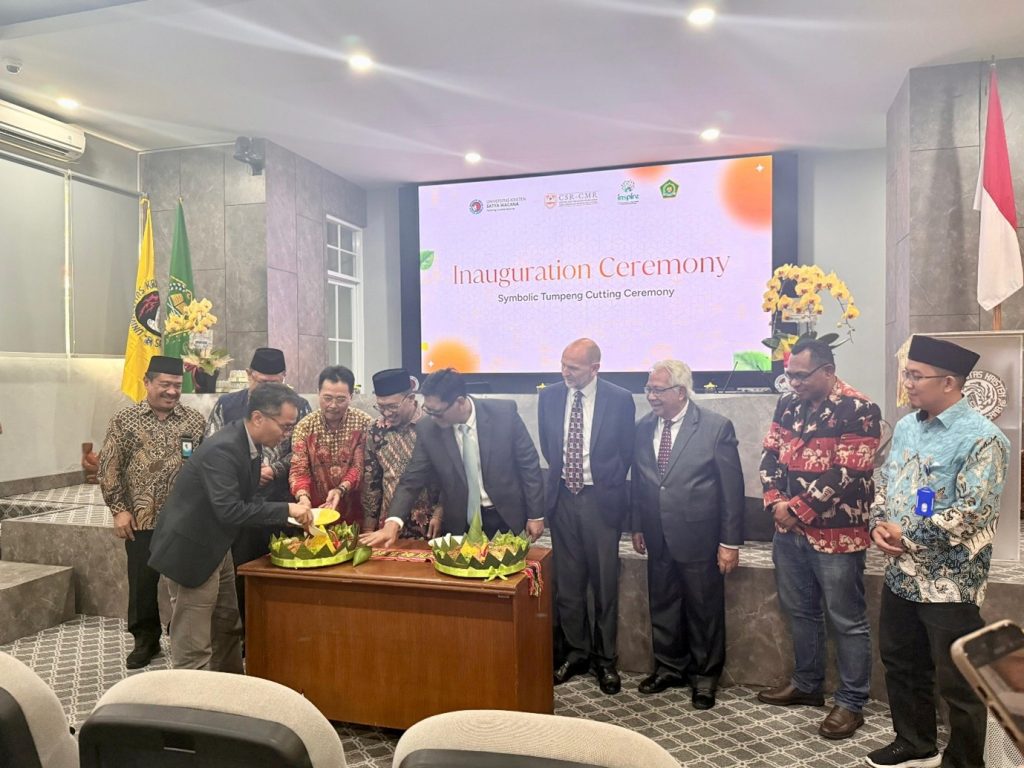
A key highlight of the event was the signing of an Implementation Agreement between CSR-CMR and the Center for Religious Harmony. The inauguration was further symbolized by a traditional tumpeng cutting ceremony, representing unity, shared responsibility, and collective hope for harmonious coexistence.
The event continued with a cultural performance from the Voice of SWCU, followed by an international seminar moderated by Dr. Arthik Davianti. The seminar featured distinguished speakers, such as Richard McCallum (Director of the Center of Muslim-Christian Studies in Oxford, U.K), Willi Toisuta (the third rector of SWCU and the chair of the Advisory Board of CSR-CMR), Samsul Ma’arif (Director of the Indonesian Consortium for Religious Studies, ICRS), and Fatimah Husain (an expert in Christian-Muslim studies and a professor at Sunan Kalijaga Islamic State University).
McCallum shared insights on the history, programs, and challenges faced by his center in promoting interfaith dialogue at his home and the global level. Toisuta discussed the historical vision of SWCU’s founding figures in fostering interreligious engagement and emphasized the strategic role of CSR-CMR for both the university and wider society. Ma’arif elaborated on the development and programs of inter-religious studies programs at ICRS in addressing religious issues through interdisciplinary approaches. Husein, moreover, presented an Islamic perspective on Muslim-Christian relations and highlighted the importance of interreligious studies in strengthening tolerance.
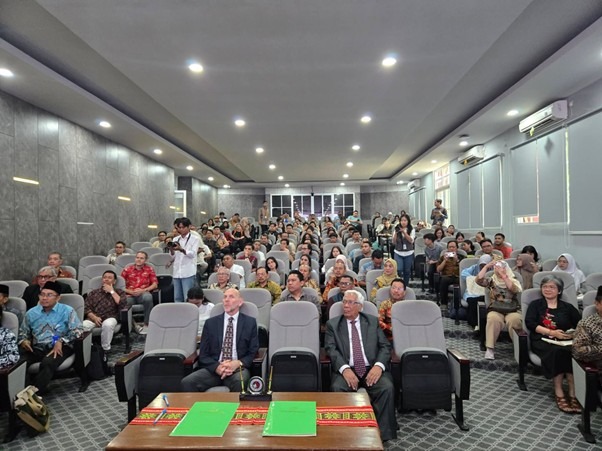
The event concluded with a shared commitment to strengthening partnerships, advancing research, and fostering an inclusive and peaceful society. As part of the program, participants also visited the CSR-CMR office at Graha Nusantara in the SWCU Kartini Campus. The visit included collaboration discussions and the signing of Memoranda of Agreement (MoA) with several partner institutions, including the Centre for Muslim-Christian Studies Oxford and the Center for Interdisciplinary Studies on Religion and Culture (chaired by Dr. Ferry Yefta Mamahit). These partnerships are expected to strengthen global academic networks and support future collaborative research and programs in interreligious studies.