
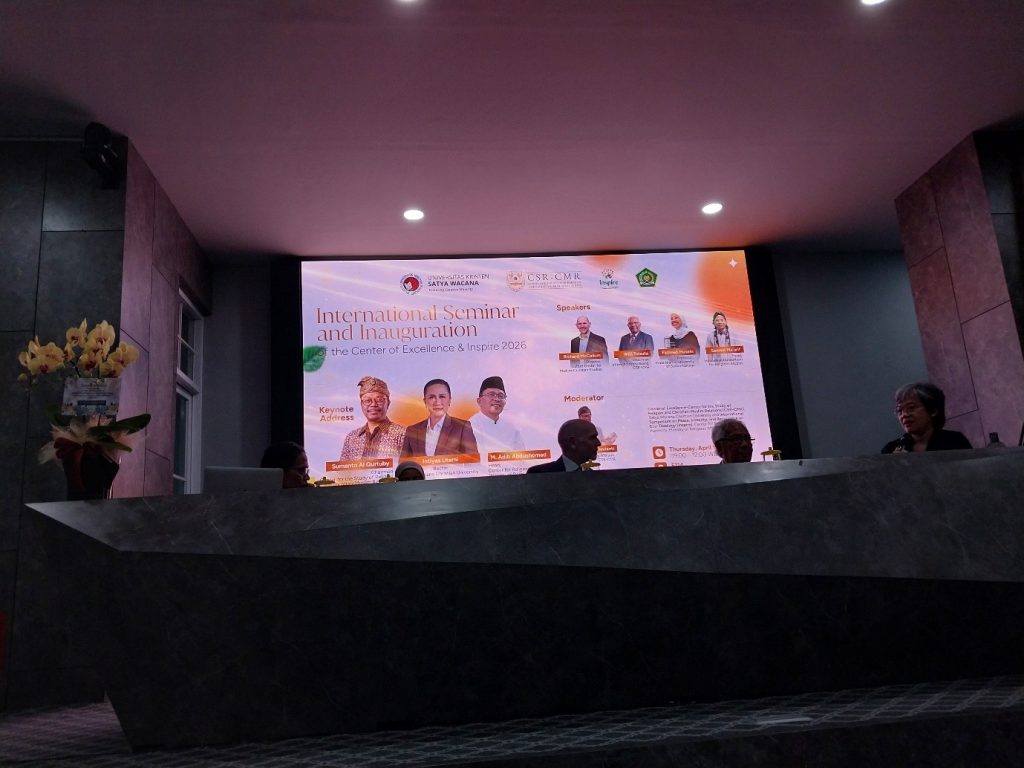
During the inauguration of the Center of Excellence of CSR-CMR and Inspire 2026 (International Symposium on Peace, Integrity, and Responsiveness to Ecotheology), the SWCU leadership expressed its support for the center’s founding. Support and encouragement were expressed by Yafet W. Rissy, Vice Rector for Partnership Affairs at SWCU and Professor of Law, who delivered a keynote speech on behalf of the rector (Prof. Dr. Intiyas Utami) during the ceremony.
After thanking the participants, including the distinguished guests and speakers, at the international seminar that marked the launch of the center, Rissy talked about SWCU’s commitment not only to fighting for justice and peace for all Indonesians but also to contributing to a just, peaceful, and harmonious global relationship between Christian and Muslims. For him, Christian-Muslim engagement is not a threat to identity but a condition of faithful witness.
Rissy also commented on the traditional tumpeng-slicing ceremony, which marked the launch of both CSR-CMR and Inspire 2026. Tumpeng, a cone-shaped rice dish or “mountain of rice,” is an iconic Indonesian centerpiece made of brightly colored rice (usually yellow turmeric rice) molded into a volcano or mountain shape, surrounded by assorted side dishes like meat, eggs, and vegetables.
According to Rissy, tumpeng-slicing is a ritual of a shared destiny. “It means that peace is not a distant ideal but a meal we prepare and eat together,” said Rissy. He also said that tumpeng
To highlight the significance of the CSR-CMR, Rissy quoted the words of the renowned theologian and interfaith activist, Professor Hans Küng: “No peace among the nations without peace among the religions. No peace among the religions without dialogue between the religions.”
Rissy added Kung’s seminal notion by stating that “no dialogue remains sustainable without legal and constitutional guarantees of religious freedom and equal citizenship.” For Rissy, the 1945 Indonesian Constitution, particularly Article 29, guarantees freedom of religion: the state is based on belief in the One God, and it guarantees all persons the freedom to worship according to their own religion or belief.
Rissy also said that the Ministry of Religious Affairs’ Center for Religious Harmony (PKUB) has long been working to translate that constitutional promise into local practices of kerukunan (harmony).
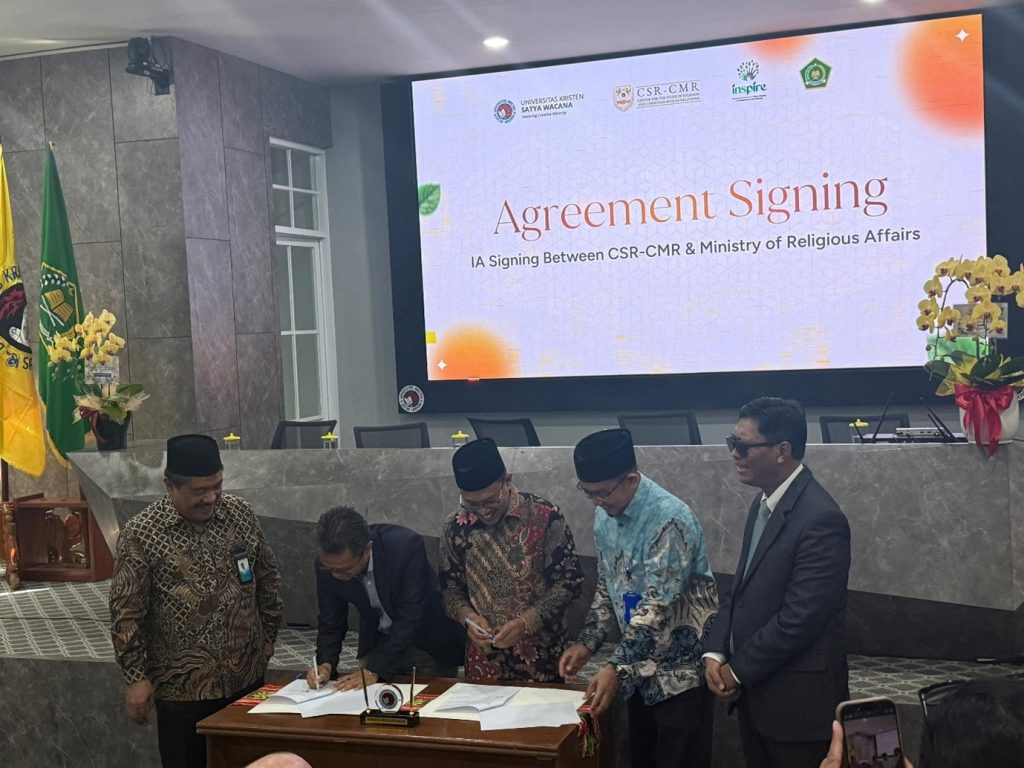
Furthermore, for Rissy, the signing of the Implementation Agreement between PKUB and CSR-CMR is “therefore a legal act with moral weight.” The pact also binds both parties to a public duty: to produce research that informs policy, and to train leaders who respect both the rule of law, love, and human dignity.
Rissy cited the work of Martha Nussbaum, a philosopher and legal scholar who works in religious liberty and the capabilities approach, arguing that a just society does not merely tolerate religious differences but actively creates conditions and opportunities for each citizen to practice their faith with dignity.
“Our center will take up this challenge. It will study not only theological texts but also lived realities: How do Christian and Muslim neighbors navigate daily disputes over loudspeakers, burial grounds, or interreligious marriages? How can customary law and national law work together to prevent conflicts?”
“These are legal questions as much as theological ones, and I certainly believe that CSR-CMR, with its academic council and advisory board, is uniquely positioned to address all these challenges.”
Rissy also cited the work of Professor Abdullahi Ahmed An-Na’im, the Charles Howard Candler Professor of Law at Emory University, who argues that religious communities must develop internal discourses of constitutionalism and civic rights, separate from state coercion. “An-Na’im’s work reminds us that interreligious peacebuilding cannot be mandated from above; it must be cultivated from within each tradition,” Rissy affirmed.
Rissy underscored the significant contributions of each seminar speaker. “Dr. Willi Toisuta traces the founding vision of SWCU’s interreligious heritage, Professor Fatimah Husein offers an Islamic perspective on Muslim-Christian relations, Dr. Samsul Ma’arif shares ICRS’s history and programs on these critical issues, and Dr. Richard McCallum describes his Oxford center’s journey toward peace between Christians and Muslims. Each of these contributions is a seed of internal, tradition-grounded peacebuilding. I do hope that CSR-CMR will nurture these seeds through comparative research, public seminars, and grassroots training.”
Not only highlighting CSR-CMR’s significance, but Rissy also underscored the vitality of Inspire 2026. He, in particular, commented on the phrase “Responsiveness to Ecotheology,” by quoting the late Wangari Maathai, Nobel laureate, who declared in her Nobel lecture as follows: “We are called to assist the Earth to heal her wounds and, in the process, heal our own – indeed, to embrace the whole of creation in all its diversity, beauty and wonder.”
Moreover, Rissy cited Seyyed Hossein Nasr (on Islamic environmental ethics) and the late Pope Francis (in Laudato Si’, 2015), who have shown that both Muslim and Christian traditions contain profound resources for ecological responsibility.
Rissy, then, raised a critical question: “How can a shared ecotheology serve as a bridge for Christian-Muslim cooperation in protecting Indonesia’s and the world’s forests, lands, air, rivers, and coasts?” For Rissy, this is not a side project, but the main duty for all of us.
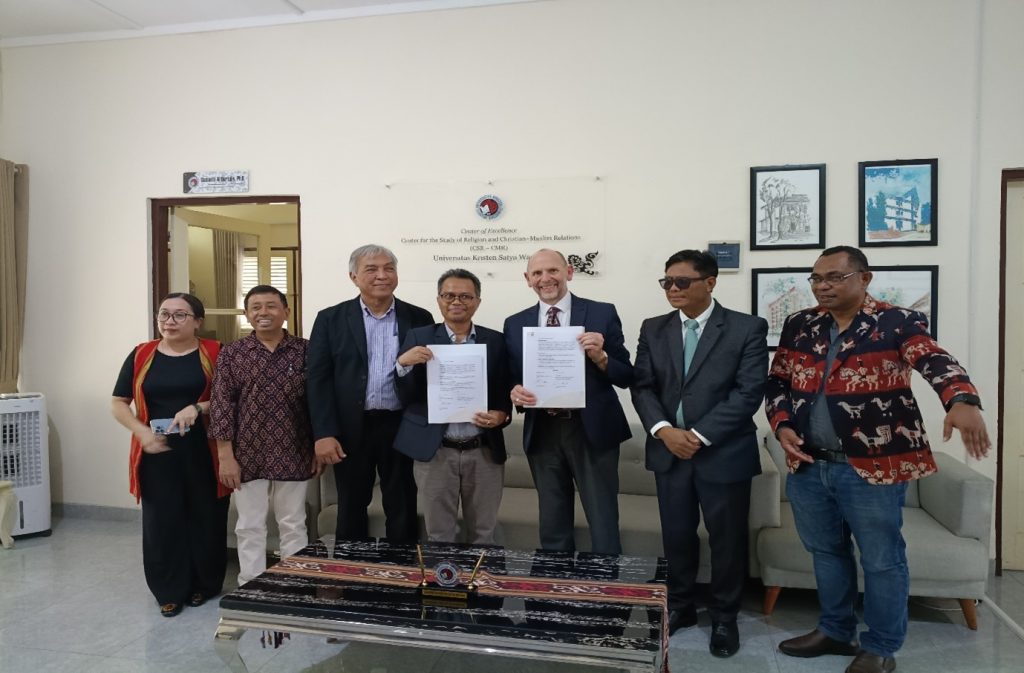
Rissy also expressed his pride and agreement for the signing of the Memoranda of Agreement (MoA) with Oxford’s Center for Muslim-Christian Studies and the Center for Interdisciplinary Studies on Religion and Culture. According to him, the MoA signifies a strong commitment and good faith to exchange scholars, co-publish research, and design joint curricula, among other good things.
“Let us build a national and global network that is both academically rigorous and locally impactful,” Rissy declared.
At the end of his speech, Rissy expressed gratitude to those involved in the center’s founding and the initiation of Inspre 2026. “I would like to take this opportunity to thank Prof. Intiyas Utami, Dr. Sumato Al Qurtuby, Dr. Richard McCallum, who flew long away from the UK to reach us here, Dr. H. Muhammad Adib Abdushomad, Professor Fatimah Husein, Dr. Samsul Ma’arif, Dr. Willi Toisuta, and Prof. Izaak Lattu, and all parties who have worked hard to realize the founding of CSR-CMR, the symposium, and cooperation with UKSW.”
*This report was based on Professor Yafet Rissy’s speech during the inauguration of the Center for the Study of Religion and Christian-Muslim Relations and the International Symposium on Peace, Integrity, and Responsiveness to Ecotheology.