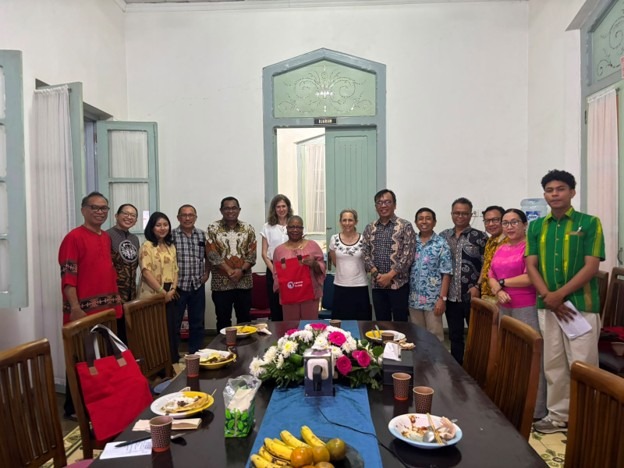
On August 25-26, Sherry L. Turner, the new president of Hartford International University for Religion and Peace (Hartford), visited Satya Wacana Christian University (SWCU). During the visit, representatives from SWCU (especially top university leadership, the Faculty of Theology, and CSR-CMR) and Hartford held a series of meetings in various locations, including Rumah Noto and the SWCU rector’s office, to discuss possible collaboration in research, teaching, and other academic and non-academic activities between the two higher education institutions.
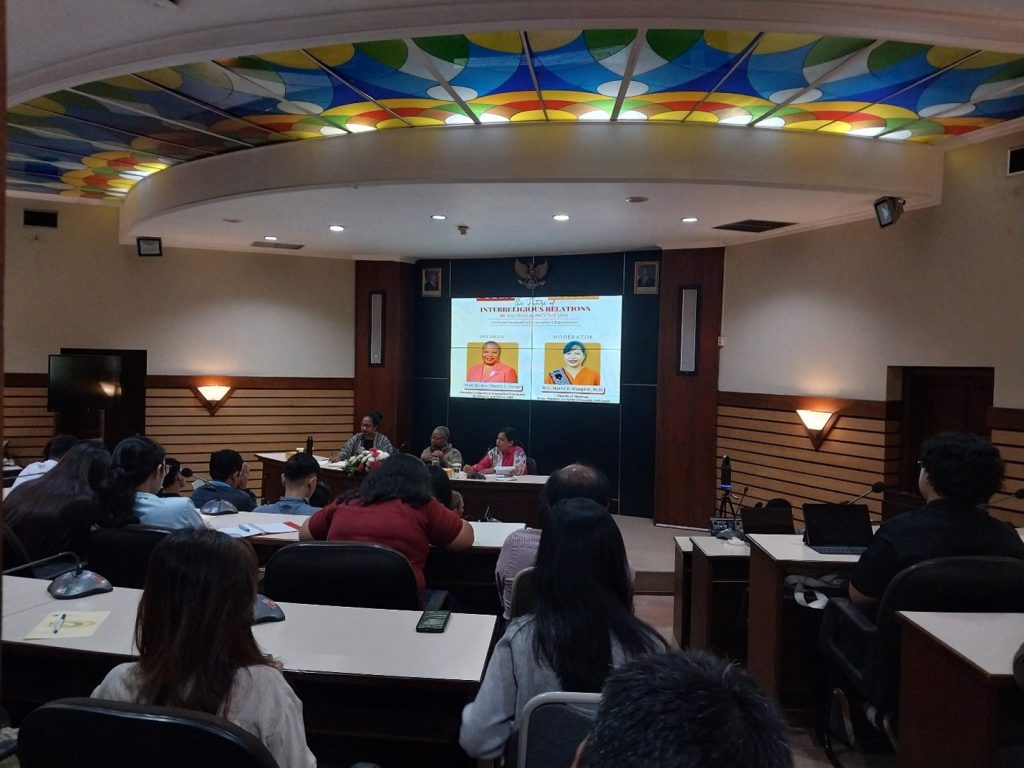
In addition to having a series of formal and informal meetings, President Turner also delivered a public lecture on “The Future of Interreligious Relations in Indonesia and the United States.” Before the lecture, held at the Probowinoto room, President Turner and her colleague, Deena Grant (Dean and Vice President of Academic Affairs at Hartford), were welcomed with a special dance, Tari Angguk, performed by two students from Satya Wacana Elementary School (SD Lab Satya Wacana). Tari Angguk conveys a message about being willing to listen to the teachings of parents, teachers, and religion.
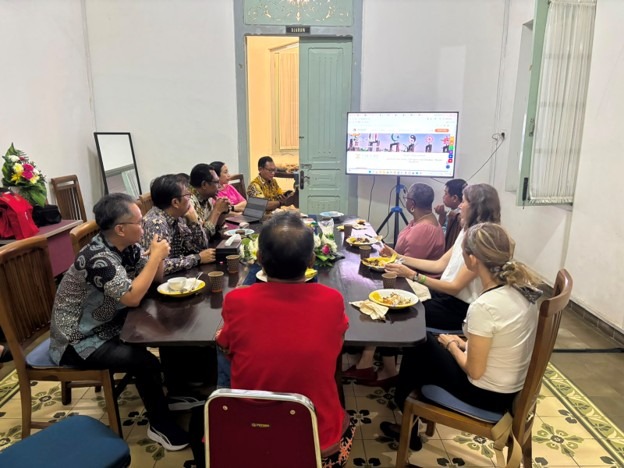
Izak Lattu, Dean of Faculty Theology, in the opening remark, said Turner’s visit to SWCU marked a further step following the previous year’s conversation between him and Turner on plans for academic collaboration between the two higher education institutions, not only in research but also teaching, publication, community services, and others.
Turner began her public lecture with a question, “What should interreligious education be in the future?” For Turner, although Indonesia and the USA have very different histories and sociocultural contexts, both have faced similar challenges, including those related to ethnoreligious diversity. Therefore, the two countries need to learn from one another, especially on how to overcome the plurality of society and religion.
She also suggested that, in the future, interreligious relations should shift from learning about each other’s religions to learning to live, work, care for each other, and conduct joint research. Turner continued with the next question, “How can we educate young people to be deeply rooted and genuinely open at the same time?”
This question forms the heart of all activities at Hartford, ensuring the institution constantly adapts to the needs of the time. She outlined the institution’s educational vision: discovery, understanding, accompaniment, and transformation. Through this vision, the research aims to foster interfaith relations as a means of peacebuilding.
In striving to realize the vision and address challenges, Turner posed a key question, “What might the next generation look like?”
This question cannot be answered through a single course, but rather by building an ecosystem. Consequently, research is essential. Turner re-emphasized the spirit of collaboration across countries, united by shared aspirations, by proposing joint classes and partner discussions.
The same applies to lecturer exchanges, scholarship, research, journal publications, and conferences.
The hope is that students will be able to build peace based on real cases. Ultimately, she emphasized that religious differences are not about demographic diversity or merely sharing the same space, but about living side by side. Participants enthusiastically participated in the public lecture by posing various questions.
During the event, SWCU and Hartford presented tokens of appreciation, underscoring the spirit of collaboration between the two institutions. After the lecture, President Turner greeted SWCU’s new students at the university main hall (Balairung), then had lunch with representatives from SWCU leadership at the rector’s office.
*Dane Dea Kumala contributed to this report.