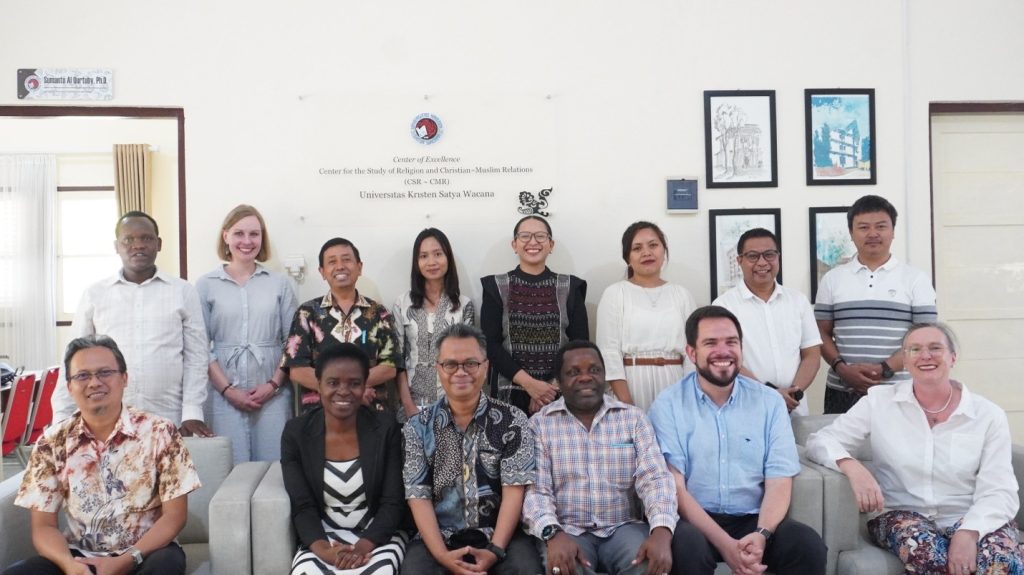
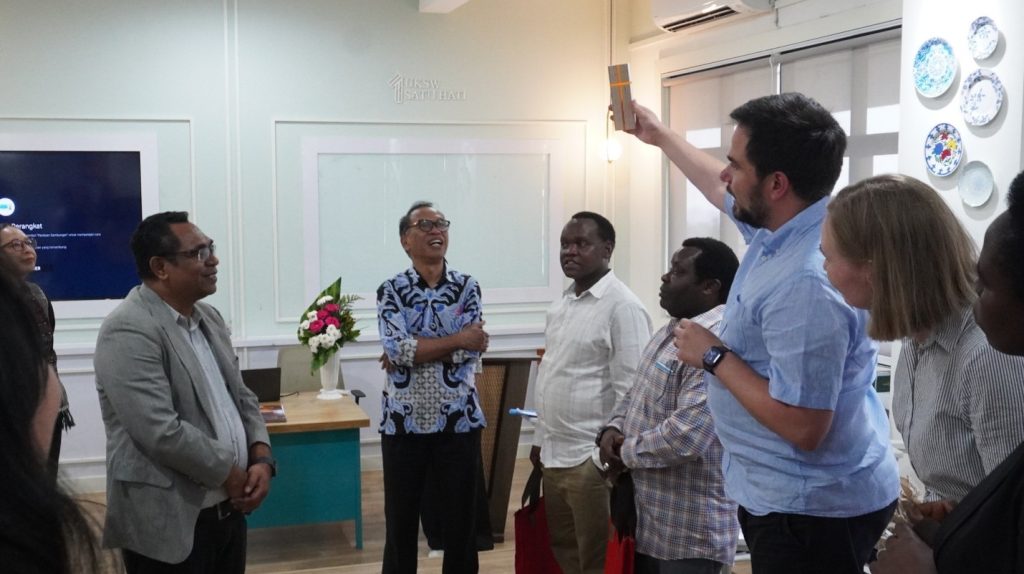
On August 27, 2026, a Christian delegation from Germany and Rwanda visited Satya Wacana Christian University (SWCU) to hold a Focus Group Discussion (FGD) with representatives from the Faculty of Theology, CSR-CMR, and the Sociology of Religion graduate students (from Indonesia and overseas). Following the FGD, the participants had lunch and informal conversations at the CSR-CMR office.
The German delegation (from the Rheinland Church of the Lennep District) included Rev. Sarah Kannemann, Rev. Conrad Almuth, and Rev. David Kannemann, while the Rwandan delegation (from EAR Kigeme Diocese) included Bishop Musabyimana Assiel, Mukanziranziza Fortunee, and Imanirakiza Felicien. This group was accompanied by reps from the Northern Central Javanese Christian Church (GKJTU): Rev. Akris Mujiyono (Chairman of the synod) and Rev. Waluyo. Moreover, reps from CSR-CMR and the Faculty of Theology included Sumanto Al Qurtuby, Izak Lattu, Irene Ludji, Suwarto, Ferry Nahusona, and Mariska Lauterboom, among others.
At least ten points emerge from the FGD.
First, religious diversity requires active engagement, not merely tolerance. All three experiences demonstrate that living together in a religiously diverse society requires continuous interaction. Germany demonstrates this through intercultural and interreligious engagement, Indonesia through everyday coexistence and grassroots interaction, and Rwanda through structured interfaith cooperation.
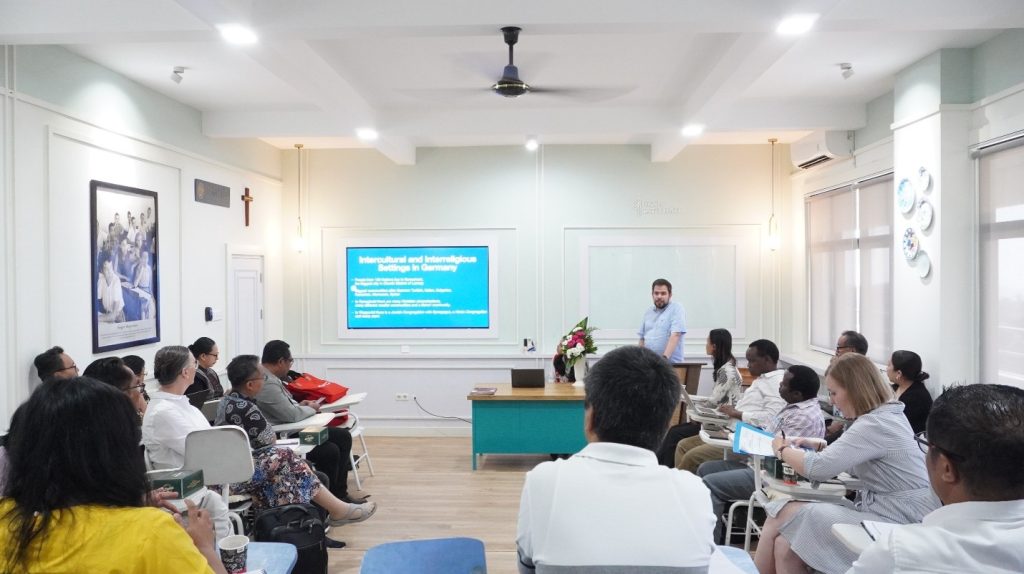
Second, historical experiences strongly influence present religious relationships. The three contexts show that religious relations cannot be separated from history. In Germany, the Holocaust has shaped Jewish-Christian dialogue, responsibility, repentance, and the rebuilding of trust. In Indonesia, colonial experiences and later political and demographic developments have influenced Christian-Muslim perceptions and tensions. In Rwanda, the 1994 Genocide against the Tutsi became a major turning point that encouraged religious communities to reconsider their role in reconciliation and peacebuilding.
Third, experiences of violence can become a starting point for reconciliation. Violence creates deep divisions and distrust, but it can also encourage communities to seek new forms of solidarity. Germany’s experience emphasizes historical responsibility and reconciliation. Indonesia demonstrates the importance of Christian-Muslim cooperation in conflict-affected areas such as Ambon and Poso. Rwanda provides a particularly strong example of communities using forgiveness, trauma healing, and interfaith cooperation to rebuild social trust.
Fourth, interreligious dialogue should move beyond formal meetings. One of the strongest common lessons is that dialogue is not limited to theological discussions among religious leaders. Interreligious engagement can occur through everyday life, cultural activities, church organizations, family relationships, social activities, and digital spaces.
Fifth, practical cooperation can build trust more effectively than dialogue alone. The three experiences show that communities can develop stronger relationships when they work together on shared concerns. These include peacebuilding, humanitarian assistance, community welfare, social development, cultural activities, and crisis support.
Sixth, grassroots communities are essential to sustainable interreligious relations. This issue matters because trust is often built through repeated personal interaction rather than formal declarations.
Seventh, education and knowledge must support mutual understanding. Misunderstanding about another religion can reinforce stereotypes and social distance. Therefore, education is an important component of interreligious harmony.
Eighth, respect should go beyond tolerance toward solidarity and justice. A common lesson from the three experiences is that peaceful coexistence requires more than simply accepting the existence of another religious group. Strong relationships involve recognition, respect, justice, mutual support, and solidarity.
Ninth, government and civil society both have important roles. Religious harmony requires cooperation between religious communities, civil society, and public institutions. The Indonesian experience particularly emphasizes the need for law enforcement, supportive regulations, active regional leadership, grassroots participation, and state-society cooperation.
Tenth, the ultimate goal is social cohesion, not eliminating religious differences. The three experiences do not suggest that Christian-Muslim harmony requires communities to become religiously similar. Instead, the goal is to maintain religious differences while developing a shared commitment to peaceful coexistence, mutual respect, justice, and cooperation.
*Rev. Irene Ludji, PhD, contributed to this report.