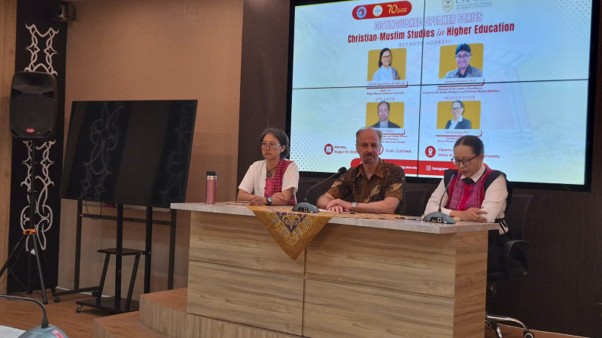
CSR-CMR held an academic event, named the Distinguished Speaker Series (DSS) on Christian-Muslim Studies in Higher Education, on August 10, 2026. The series featured Robert W. Hefner, Professor of Anthropology and Global Affairs at Boston University, President of the American Institute for Indonesian Studies (AIFIS), and a member of CSR-CMR’s advisory board. Professor Hefner is also an advisory board member of Georgetown University’s Prince Alwaleed Bin Talal Center for Muslim-Christian Understanding.
The event took place in the Diplomacy Room at Satya Wacana Christian University (SWCU) with hundreds of attendees from the university and beyond, including international visitors and students from various countries.
Sumanto Al Qurtuby, CSR-CMR chairman, in the opening remarks, explained the significance of DSS for the SWCU academic community. He said that the series, featuring eminent scholars, religious leaders, activists, government officials, businesspeople, diplomats, and other notable figures, aims to inform the SWCU community about critical current affairs and build lasting networks that bridge local and global perspectives.
The series, the chairman said, also provides a space for meaningful dialogue and connections and offers dynamic opportunities to engage with national and global issues. Another benefit of the DSS is that attendees can deepen their understanding of national and international affairs, interact with influential leaders and scholars, and meet others who share a passion for global peace and education.
The SWCU rector, represented by the Director of the Academic Directorate, Yustinus Calvin Gai Mali, welcomed the DSS initiative and offered support for inter-religious discussion and dialogue, as part of the University’s commitment to education in Indonesia.
Professor Hefner, a religious and political anthropologist and expert on global Islam and other religions, emphasized the importance of interreligious dialogue and peace. He said that Indonesia is not only special, but also a leading country in living together as a pluralistic society. Indonesia is a plural but united country, with procedures for coexistence, and it has practiced them. The main challenge of pluralism is living together in peace. At some point, Hefner said, “America needs to learn from Indonesia on how to manage religious plurality and differences.”
Hefner acknowledged the importance of Christian-Muslim studies in higher education, though he noted barriers to implementing them, since not all people, including those in academia, agree with these studies.
To bridge Christian-Muslim relations in higher education, Hefner noted that people often misunderstand a religion’s civilization, particularly how religion and state connect in terms of culture or mobility between faith and religious orthodoxy. Religious societies must adapt to modern political and economic changes; therefore, the concept of unification has significance in the separation of religion and state. Its significance is less an academic approach to practice than an understanding of religious civilization.
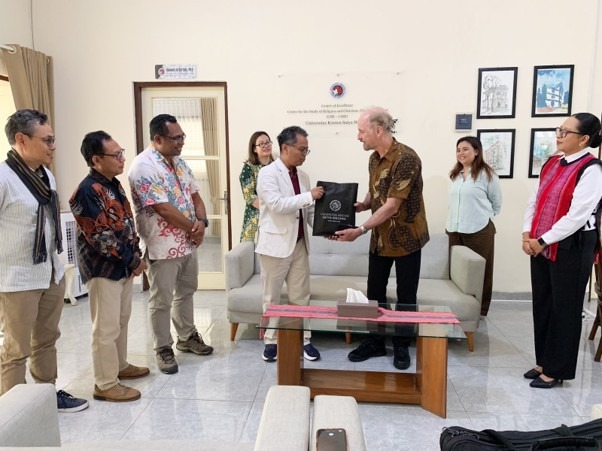
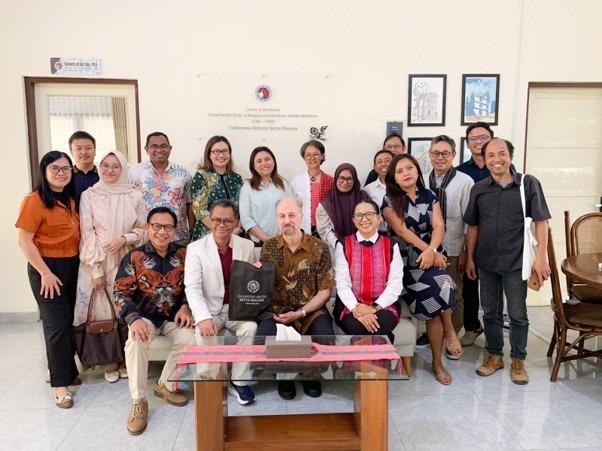
Rev. Dr. Irene Ludji, CSR-CMR Faculty Affiliate, moderated the DSS public lecture, while Dr. Purwanti Kusumaningtyas, CSR-CMR Executive Board, served as the interpreter. The event concluded with the signing of an MoU between CSR-CMR and AIFIS, followed by informal conversations at the CSR-CMR office at the SWCU Kartini campus.
*Yesi contributed to this report.