
CSR-CMR reps, Dr. Sumanto Al Qurtuby (the center’s head) and Dr. Linda Susilowati (the center’s secretary-general), presented a paper in an international conference on religion, social service, and sustainability, in June 2026. The conference, which also featured Professor Gotlind Ulshofer from Evangelische Hochschule Hessen, Germany, was hosted by the Faculty of Theology at Satya Wacana Christian University in collaboration with the university’s Center of Excellence: CSR-CMR.
Professor Ulshofer provided an overview of the role and significance of faith or religion in sustainable social services and development. In addition, she also discussed multiple aspects of Christian-Muslim dialogue in Germany. According to her, Christian-Muslim dialogue from Germany dated back in 1980s, initiated by Evangelisher Kirchentag.
Today, the dialogue is more significant than before, as Muslims have grown significantly in recent years. Ulshofer presented a survey’s result in which around 5.5 million Muslims (c. 6.6 percent of total population) resided in Germany, 45 percent oof them have Turkish origin. Unfortunately, Ulshofer has noted, around 52 percent of Germans see Islam as a threat, while only 18 percent view them as enrichment.
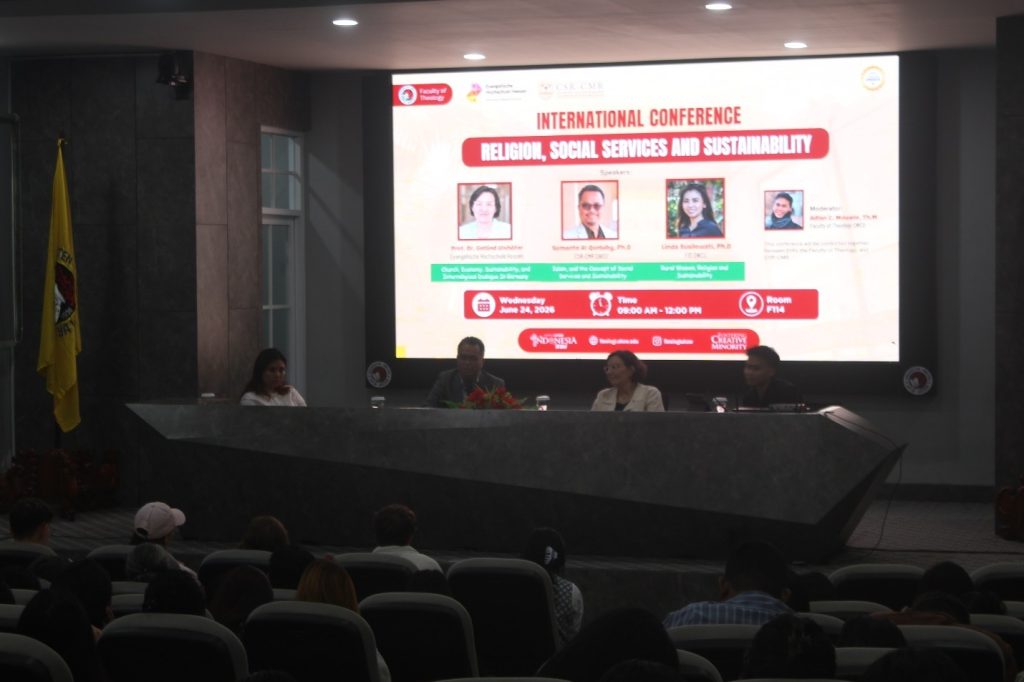
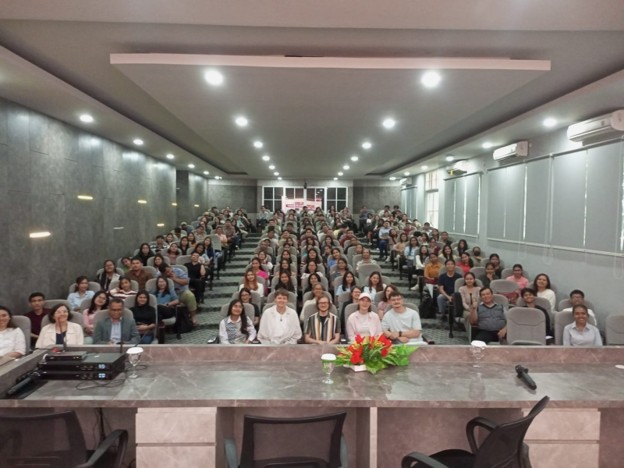
Sumanto Al Qurtuby, presented on a theme related to the concept of Islam on social services and sustainability. Sumanto has noted that although in theory, Islamic concepts on social services and sustainability are generally positive, Muslim practices do not always conform to the Islamic principles.
For examples, he said that, with some exceptions, many Muslims implement the practice of social services for Muslims or particular Muslim groups, not for human societies regardless of their religion, or for preserving nature and animals, while Islam clearly emphasizes the importance and sustainability of humans and nature. Services for all humans and environment are part of fundamental teachings of Islam and the Qur’an.
Furthermore, Sumanto also underscored the shortcomings of Islamic charities include spending on selected Muslim-related matters and projects (e.g., mosques, Islamic schools, Palestinian cause, etc.). Segregated or exclusive Muslim charities (i.e., the charities from and for certain Muslim groupings) become ubiquitous phenomena among some Muslim communities.
In brief, Sumanto highlighted the ambiguity and paradox of Islamic teachings and texts, noting that this also applies to other religions, as well as underscored the contributions of religion (including Islam) to crimes, including environmental damage, as evidence by the contest between the tambang (mine) group versus the lingkungan (environment) group.
Linda Susilowati, moreover, presented a paper on religion and sustainability in rural Central Java, emphasizing the role of women. More specifically, her paper examines how religion shapes rural women’s livelihoods in two villages in Wonogiri Regency, Central Java, drawing on her doctoral ethnographic research.
Using Social Reproduction Theory and the Sustainable Livelihoods Framework, Linda argues that religion operates as two simultaneous forces in these women’s lives.
First, as an institution, religious-cultural discourse–expressed through concepts like kodrat (natural destiny) and kewajiban (obligation)–legitimizes an unequal distribution of household labor, often re-imposing a domestic hierarchy even when a woman’s economic standing would suggest otherwise.
This discourse, Linda said, reinforced for decades by state doctrine such as the New Order’s PKK (Pemberdayaan dan Kesejahteraan Keluarga-Family Welfare Empowerment) programs, naturalizes women’s reproductive labor as sacred duty rather than negotiable choice, making household and economic sustainability structurally dependent on labor that is mandated, not chosen.
Second, and at the very same time, religion operates as social capital: communal religious gatherings provide women with real, material support during crises, such as financial aid, labor assistance, emotional solidarity, though access to this network depends on being seen to conform to the very norms that constrain them.
Women navigate this duality through what the research terms strategic conformity: complying visibly while negotiating quietly, drawing on the same religious sphere that limits them in order to cope and persist.
The presentation’s core argument is that sustainability in this context is not gender-neutral; it is built on women’s labor and resilience, which religion itself both shapes and sustains, and closes with a challenge to faith-based and academic institutions alike to confront both faces of religion rather than either romanticizing women’s resilience or simply condemning religious tradition.